Edit Guide
  Transportation
  Banking Services
  Post Office
  Medical Services
  Telecom
  Survival Guide
 Transportation:
Different modes of transportation include subway, bus, and train, amongst many others! The subway is the most convenient to get from one place to another. However, it is best to do some homework on studying the subway system before travelling as getting to one destination might require many transfers. Getting used to walking long distances is important too! In Korea, automobiles drive on the right while people usually walk up the stairs on the left.
The T-money transport card can be used for both the subway and buses in Seoul. It can also be used in other major cities like Busan. The student identification cards issued by Korean universities have the T-money function.
Subway
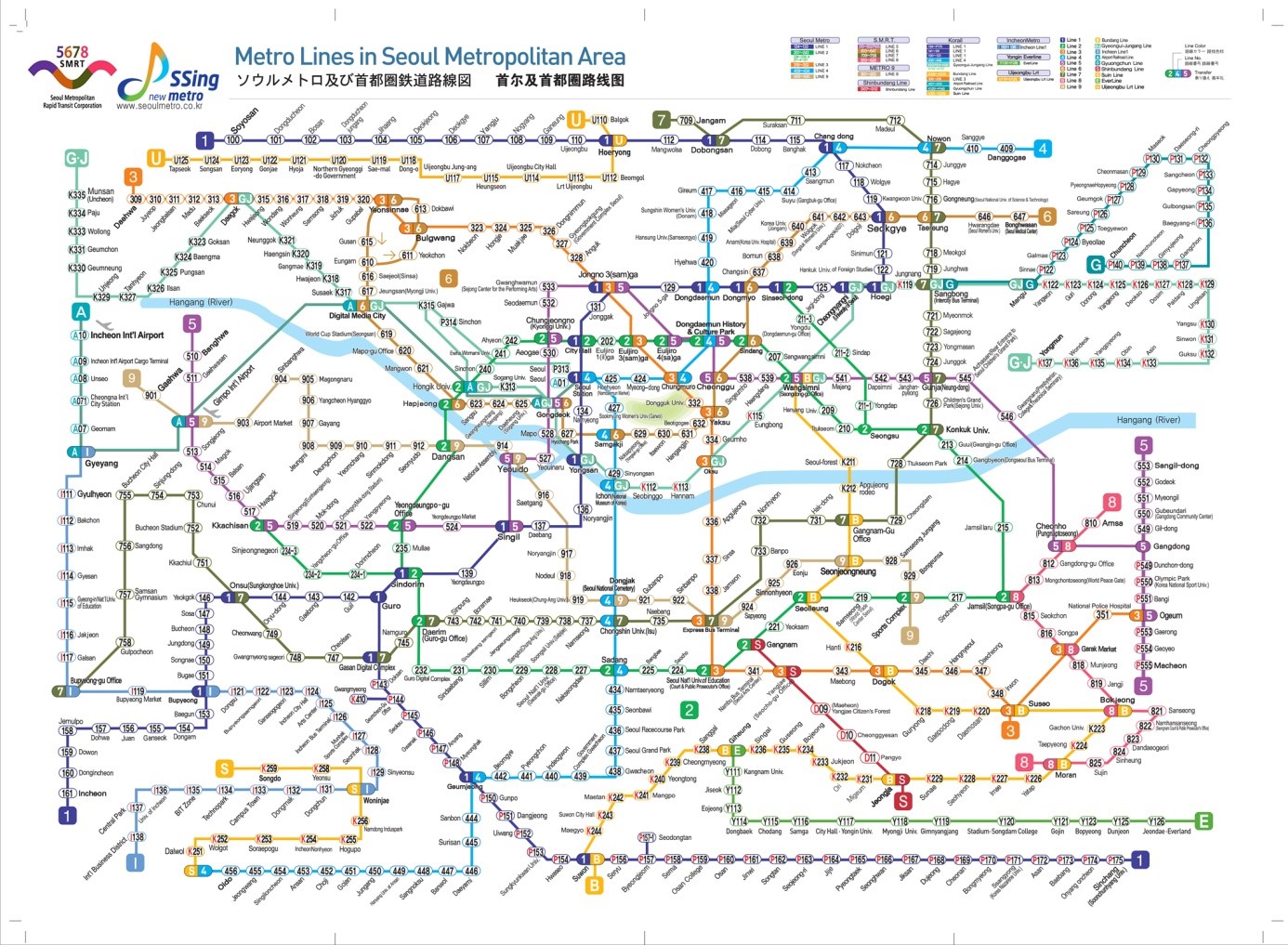
Seoul boasts one of Asia’s most comprehensive subway systems that allow commuters to get to most parts of the city without having to transfer to another mode of transport. While it may be convenient, the complex network of subway lines may prove to be daunting for first-time visitors to the country.
Flying Chalks recommendations: There are many free mobile applications that you can download to help navigate Seoul’s subway system.
- For Android users, you can download “Subway Korea” or “Korea, Seoul Metro Navi”.
- For IOS users, you can download “Subway Korea” or “Seoul City Metro Lite”.
- For those who can read and understand basic Korean, the highly popular “Daum Maps” can help you navigate around by recommending the fastest options via public bus and subway.
Basic fare for 10km: 1050 KRW (Transit card); 1150 KRW (Ticket)
Total distances exceeding 10 km (within Seoul): 100 won for each additional 5 km
Total distances exceeding 40 km (within Seoul): 100 won for each additional 5 km
To begin your commuting journey, simply purchase a transit card (more commonlnal 10 km
Total distances exceeding 30 km (outside Seoul): 100 won for each additioy known as the T-money card) at any of the ticketing machines or from the metro office located at the stations.
Interactive subway map can be found here!
Seoul Bus
Apart from subway, buses are another convenient form of transportation.
Express and Intercity bus
Express and Intercity buses are the most popular option to get region to region. The extensive network of buses offers a comfortable and convenient way to get to and from even the smallest towns in Korea.
For more information, you can visit:
http://english.visitkorea.or.kr/enu/TRP/TP_ENG_5_2.jsp
Rail
Another favoured option to travel between cities in Korea is by train.
Seoul is connected to the country’s other cities via train networks. Ticket prices depend on the distance travelled and the train classification. KTX trains offer high-speed travel with comfortable seating. For the budget conscious, there are cheaper options such as the Mugunghwa trains. Taking the train is a good way to experience travel in Korea and enjoy the special rail lunch box sets available at the train stations.
Click here for railroad map.
Click here for more details on the KR Pass.
Taxi
Taxis are plentiful, clean, safe, and affordable in Korea.
Taxi Fares (as of December 9, 2013)
Regular Taxis [mid-size] | |||
Basic fare | Region | Additional Fare | Details |
2,800-3,000won | Varies by region | Fare calculated by | In Seoul, Gyeonggi, Incheon and Busan, a surcharge of 20% applies during late-night hours (midnight-4am) and in suburbs (N/A for other cities). |
Deluxe and Jumbo Taxis | |||
Basic fare | Region | Additional Fare | Details |
3,200-5,000 won | Varies by region | Fare calculated by | There are no surcharges for |
Flying Chalks tip: Deluxe taxis can be recognised by its signature black body with a yellow sign on the top. Avoid hailing these taxis should you not want to find yourself paying more than the usual for a ride.
Domestic flights
Ferries
Banking Services:
To set up a bank account, you will require:
- Valid passport
- Alien registration card (as proof of residency)
Once a bank account is open, the bank will issue a check card with ATM deposit / withdrawal functions (in Korean won). The time taken to issue check cards may vary by bank.
Flying Chalks’ tip: Hana Bank is available in Korea University campus!
Major Banks in Korea:
Korea Exchange Bank (KEB)

Of all local commercial banks, Korea Exchange Bank (KEB) is the only one that offers foreigners-only bank accounts that record all transactions in English.
Procedures:
- Visit the nearest Korea Exchange Bank (KEB) branch
- Take a ticket from the queue ticket machine at the Foreign Exchange section and wait for your turn
- Proceed to the desk that displays your number
- Present your passport and alien registration card in order to open a bank account. Apply for a check card with ATM deposit / withdrawal functions
Opening hours: Hours: 09:00-16:00 (Monday-Friday; closed on holidays)
Their homepage is available here!
Customer Service: +82-2-3709-8080, 1544-3000
Hana Bank

Check cards with ATM deposit/withdrawal functions are issued on the spot. The Hana Bank World Centre branch in Jung-gu, Seoul offers consultation in English.
Opening hours: Hours: 09:00-16:00 (Monday-Friday; closed on holidays)
Their homepage is available here!
Customer Service: +82-2-520-2500, 1599-1111
Kookmin Bank (KB)

Check cards with ATM deposit/withdrawal functions are issued on the spot.
Opening hours: Hours: 09:00-16:00 (Monday-Friday; closed on holidays)
Their homepage is available here!
Customer Service: +82-2-6300-9999, 1599-9999
Shinhan Bank
ATM cards are issued on the spot while check cards are issued after three months of opening the bank account.
Opening hours: Hours: 09:00-16:00 (Monday-Friday; closed on holidays)
Their homepage is available here!
Customer Service (09:00-17:00): 1577-8380 (Extension: #1-English, #2-Japanese, #3-Chinese, #4- Vietnamese)
Woori Bank

You will be issued the check card and a bank book on the spot. There is no charge for opening the bank account as with most banks in Korea.
Customer Service (for foreigners): 1599-2288 (Extensions 1-7 for English, Chinese, Japanese, Vietnamese, Mongolian, Thai or Indonesian speaking service)
Post office Services:
Flying Chalks’ tip: Regular shipping will set you back about SGD $5 per kilogram of postage.
Medical services:
With Korea being a developed country, it may be surprising to foreigners that there is a lack of private clinics and most Koreans either go to hospitals or simply buy medicine from pharmacies to treat their illnesses.
Hence, you will be glad to know that Korea University has a hospital on its campus near to Anam subway station! The Korea University Anam Hospital is a tertiary referral hospital, home to renowned specialists in various fields of medicine.
Flying Chalks’ tip 1: For those who are worried about potential language barriers, rest assured that you will be well taken care of by the International Health Care Center at the Anam Hospital. The Center is staffed by doctors and nurses who are fluent in several languages, most common being English, Chinese and Japanese.
Flying Chalks’ tip 2: Korea University offers its students the Student Health Cover (SHC) where in return for a KRW $20,000 fee, you can enjoy free treatments of minor illness at KU Student Health Service on campus. In addition, you will also receive about 50% concession on medical examination fees at all KU hospitals and about 70% concession for purchasing medicine at pharmacies appointed by Korea University.
Medicine
Pharmacies are located all over the city and can be identified with a sign that reads, 약국 or "Yak". You can purchase both prescription and over-the-counter drugs for colds, headaches, and other minor ailments there.
Telecommunications:
There are 3 mobile telecommunications service providers in Korea: KT, SKT, and LG U+. These providers operate authorized service centres and phone retail stores called 공식 인증 대리점 (gongsik injeung daerijeom), where you can subscribe to a phone service and purchase a mobile phone. An authorized store should carry the logo of its parent company as well as a sign that says “공식 인증 대리점.”
KT
KT operates authorized stores with signs that read “Olleh”. The most representative KT center, located in Gwanghwamun offers consultation in 17 different languages.
SK Telecom
SK Telecom operates authorized stores with signs that read “T World” or “SK Telecom” as well as a customer call center exclusively for foreigners. You can call the customer center to find out which stores provide interpretation services as not all of them do.
LG U+
LG U+ operates authorized stores with signs that read “LG U+”.
Weather:
Korea’s climate is characterized by 4 distinct seasons: spring, summer, fall, and winter.
Spring
Lasts from late March to May, and is signalled by the picturesque sight of cherry blossoms blooming all over the country.
Summer
Lasts from June to early September. It is a hot and humid time of the year where temperatures can soar above 30 °C in some areas.
Autumn
Lasts from September to November. It is generally regarded as the best season to visit Korea with its cool temperatures and scenic autumn foliage.
Winter
Lasts from December to mid-March, where temperatures can plunge to as low as −20 °C in some areas.
IMPORTANT NUMBERS | |
General nationwide emergency hotline that can be used to call for an ambulance, fire truck or police | 119 |
Police | 112 |
BBB (Before Babel Brigade) can be dialed if you are having difficulty communicating in Korea. It has 2,400 volunteers fluent with 17 foreign languages who will help you with translation problems whenever and wherever via mobile phone. | 1588- 5644 |
Tourist Complaint Centre | 02-735-0101 |